


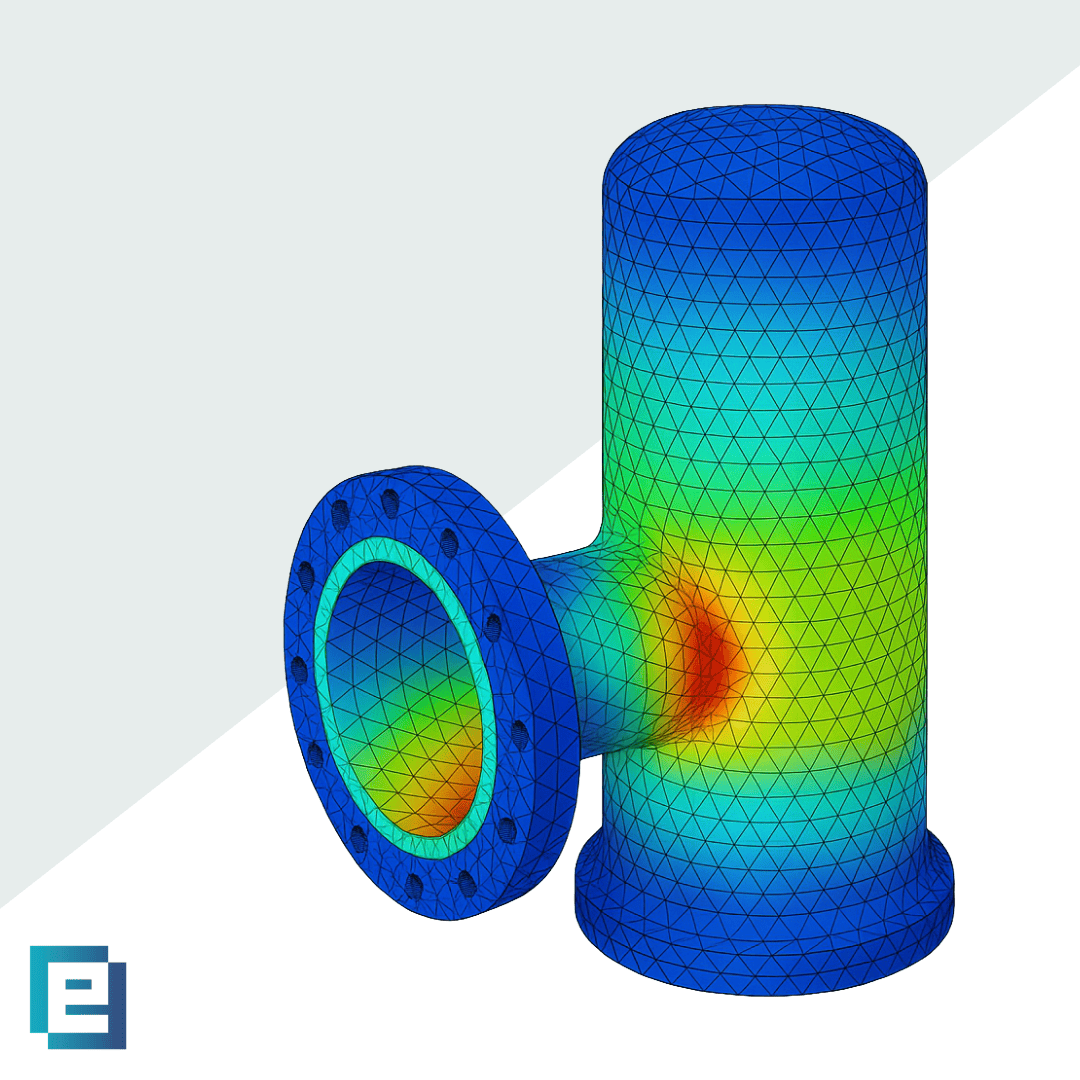
DIN EN 13445-3 is one of the key standards for the design and calculation of unfired pressure vessels. It therefore provides an essential basis for the design of safety-relevant components in mechanical and plant engineering, energy supply, medical technology, and flow-demanding applications such as pumps or valves. Annex B in particular plays a key role, as it describes the structural-mechanical behavior of complex vessel geometries using finite element analysis (FEA). This enables precise, simulation-based design with clearly defined verification criteria.
The focus: Annex B as the foundation of modern, simulation-based design
Compared with other established codes and guidelines such as the FKM guideline, VDI 2230, or Eurocode 3, Annex B stands out for its direct focus on pressure-retaining components, which typically exhibit strongly nonlinear load paths, local stress peaks, or complex thermo-mechanical load spectra. The standard requires a numerical assessment of stresses based on elastic or elastic-plastic FE models, thereby demanding and promoting a deep understanding of actual component behavior. This very approach forms the basis of modern virtual product development, as it represents real operating conditions far more realistically than simplified, conservative calculation methods.
Structured procedure in accordance with DIN EN 13445-3 Annex B
Code-compliant design begins with the creation of a representative FE model that includes all load-bearing areas while achieving an efficient balance between model detail and computational effort. In accordance with Annex B, simplifications, element types, and meshing strategy must be selected so that local gradients such as notch stresses and weld details can be captured precisely. Especially for pressure vessels with nozzles, reinforcement rings, or transition radii, the use of quadratic solid elements is recommended to ensure high result accuracy.
This is followed by the definition of load cases, which typically include internal and external pressures, thermal gradients, preloads, self-weight, and additional mechanical load components. With thermally loaded components—such as in energy supply plants—the calculation of coupled temperature and structural fields becomes crucial in order to transfer both steady-state and transient temperature fields correctly into the structural model.
A key step is stress linearization, in which the calculated stresses are assessed in accordance with the standard’s classification (Primary General Membrane Stress, Primary Local Membrane Stress, etc.). The standard requires precise extraction of the stress components, as the computational proof of safety is derived from them. This is where the advantage of simulation-based design becomes evident: Annex B enables location-specific assessment—particularly in regions where analytical approaches would lead to overly conservative or, in the worst case, insufficiently accurate results.
Practical application in typical customer projects
Mechanical engineering companies benefit in particular from the detailed procedure in accordance with Annex B when assessing highly loaded frame structures, pressure vessel connections, or media-carrying components. For medical technology applications, the relevance of the standard becomes especially apparent when thin-walled components or micro-structured internal channels are analyzed. Energy-generating plants—especially wind energy or power-to-heat systems—are also increasingly relying on simulation-based verification to accurately represent vibration and pressure load spectra.
A practical example is the analysis of a pressure-loaded vessel with several connected and stiffened flanges. While an analytical approach in accordance with Annex C provides only limited insight into local hot spots in the transition region, an FE simulation in accordance with Annex B enables model-based assessment of plastic deformation reserves, permissible membrane and bending stresses, and the actual safety margins.
Advantages over alternative standards and codes
While other guidelines such as the FKM guideline primarily focus on mechanical components without significant internal pressures and Eurocode 3 mainly addresses steel structures, DIN EN 13445-3—especially Annex B—provides a tailored basis for the design of pressure-retaining components where the interaction of pressure, temperature, and structural compliance is critical. The ability to incorporate real material properties, nonlinear load cases, and different load-path combinations delivers significantly greater informative value than purely analytical methods.
In addition, compared with the AD 2000 guideline, DIN EN 13445 already includes a stability assessment, which plays a major role, for example, in vacuum chambers.
Conclusion – Precision through simulation delivers safety and cost-effectiveness
Applying DIN EN 13445-3 Annex B reflects the state of the art in the numerical design of pressure-retaining components and enables precise and cost-effective design. Companies benefit from realistic simulations, an objective safety assessment, and the ability to optimize components in early project phases. For companies developing demanding components, simulation-based assessment in accordance with Annex B provides the ideal basis for safe, efficient, and code-compliant designs. Those who want to leverage this potential for their products benefit from expert consulting and a sound numerical analysis—an essential step toward robust, future-proof product design.