


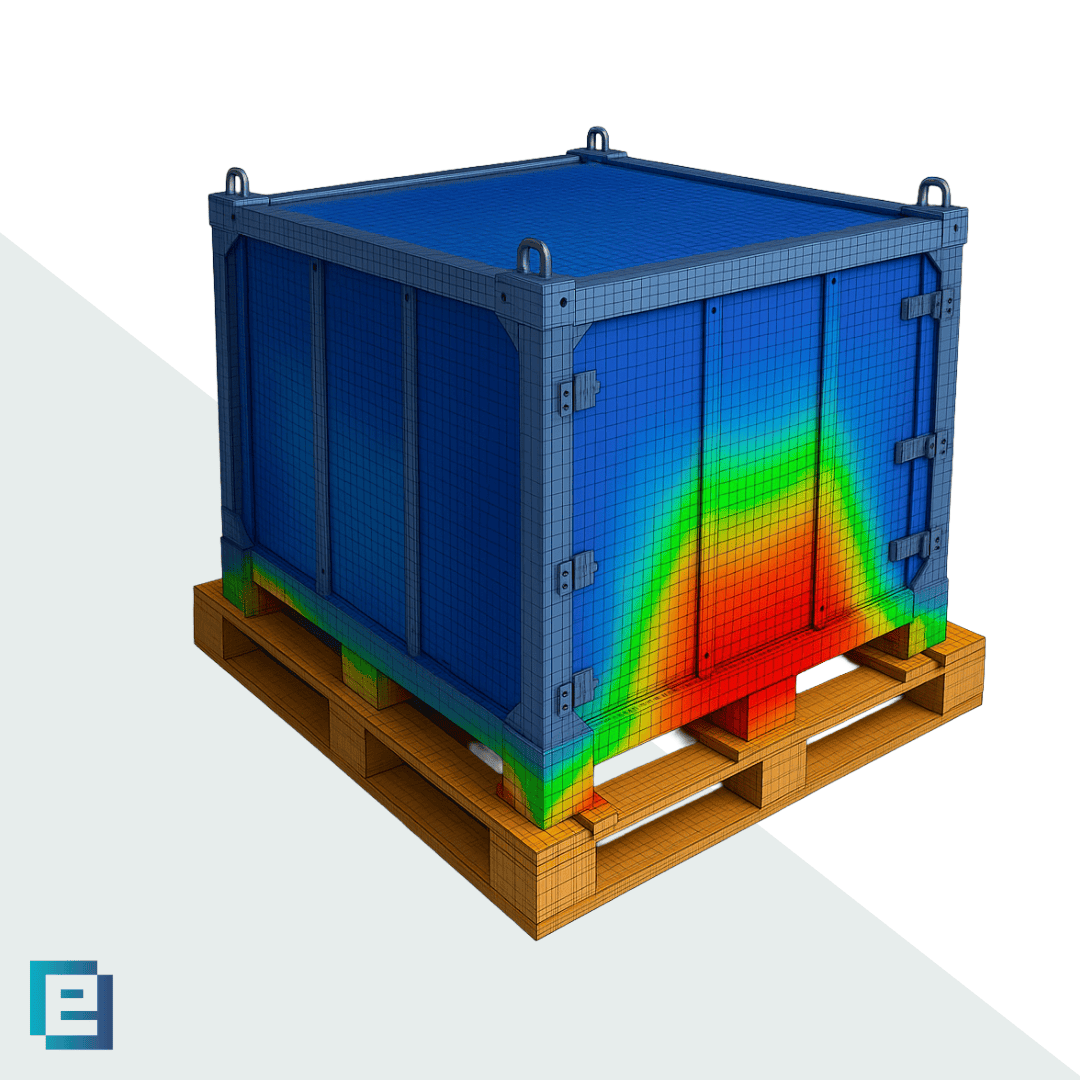
Transport places significant mechanical loads on components and products. Vibrations, shocks, and impacts act on materials and structures long before they reach their place of use. Especially in industrial supply chains where sensitive components, complex assemblies, or difficult-to-transport equipment are moved, reliable prediction of such loads is crucial. Virtual transport simulations enable a realistic reproduction of these loads – precise, reproducible, and without costly physical test series.
Using physically accurate models, e.g., in accordance with IEC standards such as DIN EN IEC 60721, and excitation profiles based on measurement data, critical stresses, deformations, and vibrations can be determined as early as the development phase. In this way, components and packaging can be designed to withstand actual transport loads and to ensure functional safety even after transport.
Simulation of real transport environments
A transport simulation maps the various phases of the flow of goods – from internal handling and road transport through to air and sea freight. The basis is defined load sequences that replicate real transport conditions. These include, for example, vertical and horizontal shocks, drop and impact events, and long-term vibrations.
Each simulation is based on a sequence of loads that act on the component or packaging one after another. This includes drop tests from defined heights, compression due to stacking loads, and in particular stochastic vibration excitations as occur during truck or rail transport. The load time histories are described using specific power spectral densities (PSD) that reflect the actual vibration intensities from field measurements.
By coupling these input data with a detailed FEA model, local stresses and deformations in the component can be calculated. Based on these results, it becomes clear whether a design remains stable under dynamic influences or whether critical weak points are present.
Random vibration and dynamic testing
A key element of transport simulation is random vibration analysis, which examines the component’s behavior under randomly distributed vibration excitations. In contrast to sinusoidal vibrations, which excite only a single frequency, the random method represents the entire frequency spectrum of real transport vibrations.
For the calculation, power spectral density excitations are applied to defined contact surfaces or support points of the model. This makes it possible to see how dynamic energy is distributed across the frequency range and which natural frequencies lead to increased loading. This method enables a realistic assessment of loading over an entire transport – especially for components exposed to uniform vibrations over long periods, such as during truck or rail transport.
The use of nonlinear material models and contact-based couplings within the FEA simulation ensures that deformations, damping effects, and plastic reserves are taken into account in a physically correct manner. In this way, microcracks, loosening, or resonance damage can be identified in the virtual prototype at an early stage and avoided through design measures.
Vertical vibration testing of complete packages
In addition to simulating individual components, the analysis of complete transport packaging and unit loads plays a central role. The systems are subjected to vertical random vibration profiles that represent characteristic acceleration levels and frequency spectra.
The objective is to assess the protective effect of the packaging and the structural integrity of the product within the overall system. By numerically reproducing the loading across the entire frequency range, it can be verified whether the packaging system sufficiently damps vibrations or whether excessive load peaks are transmitted to the product.
In industries such as mechanical and plant engineering, energy, or vessel construction, this aspect is particularly relevant. Large components or units that are often transported as a single unit on pallets or frames experience a wide range of vibrations that can be reliably represented in the simulation.
From virtual testing to a safe product
Our simulations enable early detection and prevention of damage and failures. All transport phases can be mapped digitally, and the design can be specifically aligned with real loads. In addition, optimization potential can be identified – for example by adjusting wall thicknesses, bracing, or mounting points.
The results obtained serve as evidence that a product can withstand the mechanical influences during transport without suffering impermissible deformations or loss of function.
Conclusion
Virtual transport simulations combine practical load scenarios with the precision of modern FEA analyses. They provide the basis for preparing products for transport safely, efficiently, and in compliance with standards – regardless of whether they are shipped by road, rail, sea, or air. In combination with guidelines for strength assessment, such as the FKM guideline or VDI 2230, this enables reliable statements to be made about the strength of your components.
If damage occurs to your equipment during transport, targeted optimizations can be developed to prevent it. Please feel free to contact us without obligation to request a free consultation appointment.