

An excerpt from our daily work – Simulation instead of downtime: Fatigue analysis of a storage and retrieval machine
Storage and retrieval machines (SRMs) are the heart of modern high-bay warehouses. They move at high speeds through narrow aisles, lifting and lowering loads over heights of several dozen meters, and must maintain maximum precision at all times. The dynamics of these systems mean that the structures used are exposed to significant alternating loads. If damage occurs to load-bearing components, the result is not only repair costs but also expensive production downtimes.
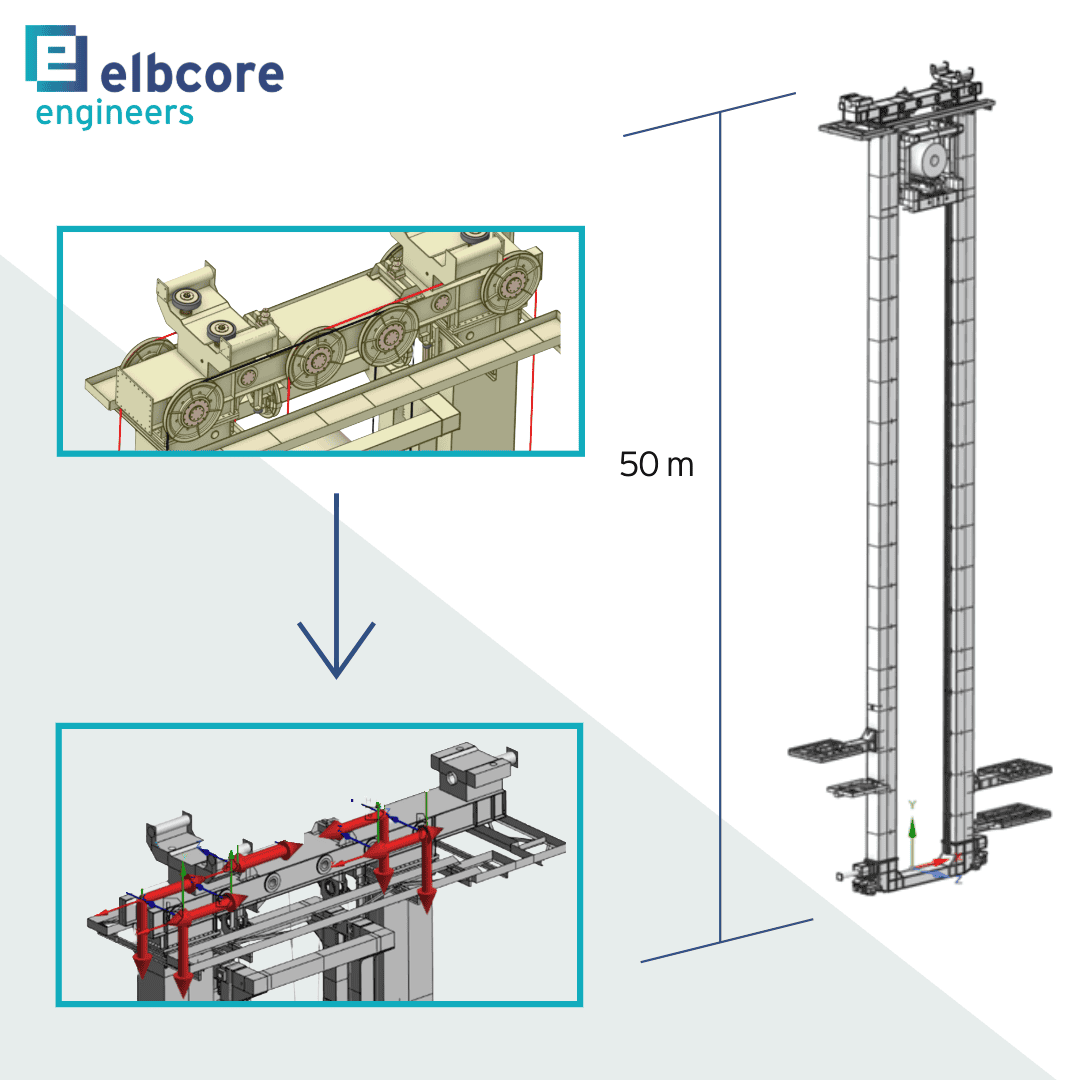
In a recent project, we faced exactly this challenge: damage had become visible on the top carriage of a storage and retrieval machine. Cracks indicated a classic fatigue problem – a consequence of recurring loads that stress the material over long periods. For the operator, a central question arose: Should the affected SRM, which is approximately 50 meters high, be completely replaced – involving high investments and long downtimes – or can an equally safe but significantly more economical solution be achieved through targeted repair measures?
Realistic Simulation as the Key
Answering this question was only possible if the actual operating conditions of the machine could be accurately reconstructed. Only a realistic representation of the load scenarios allows the cause of the damage to be identified and the service life to be correctly assessed.
A particular challenge was that no current design data for the machine was available. Instead, we had to build the calculation model based on existing old drawings and repair measures already carried out. These were carefully digitized and transferred into a numerical model so that all relevant geometries were captured. This created the basis for mapping the real operating data in an FEA analysis.
Subsequently, we analyzed the load data recorded during operation in detail and fed it into the model. Using the Finite Element Method (FEA), all relevant load conditions – from acceleration and braking processes to varying lifting movements – could be simulated. This resulted in a complete picture of the stress situation in the top carriage.
It was particularly important not just to use idealized load assumptions, but the actual load collectives. This was the only way to ensure that the simulation corresponded to real operating conditions.
Assessment according to FKM Guideline
The FKM guideline “Analytical Strength Assessment of Components in Mechanical Engineering” was used for the subsequent assessment of fatigue safety. This has been established for many years as the standard in mechanical engineering for calculating fatigue strength and predicting service life under real load collectives.
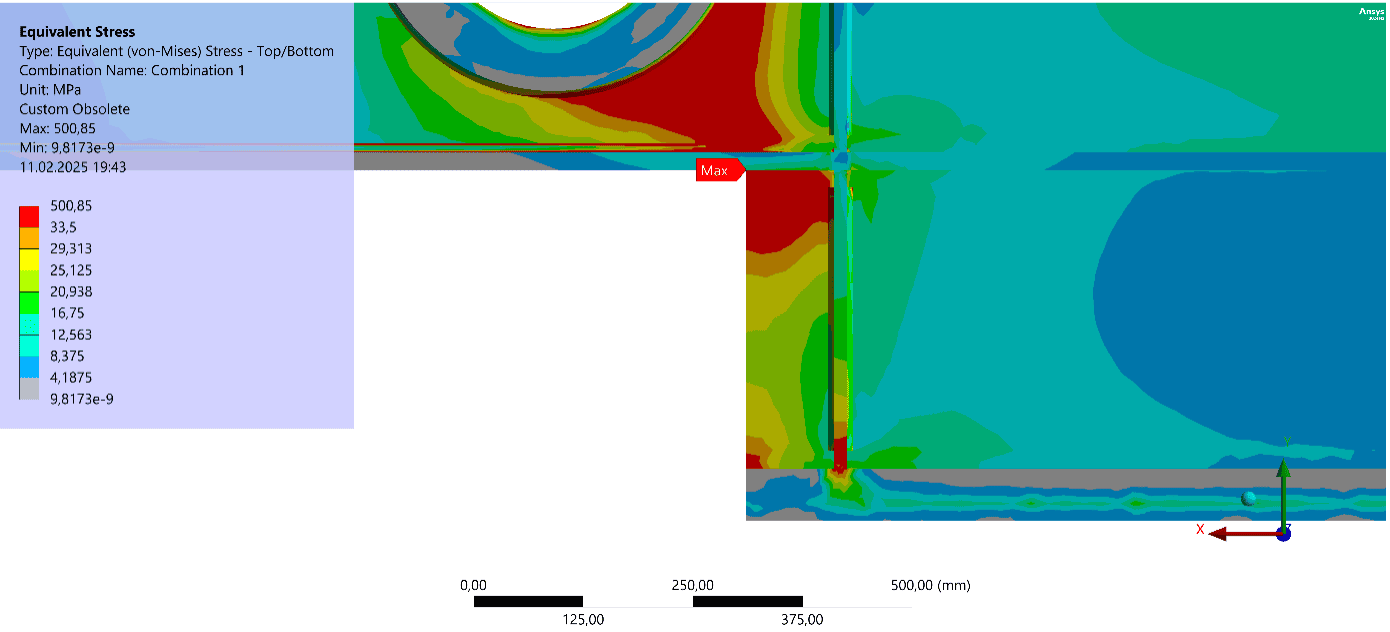
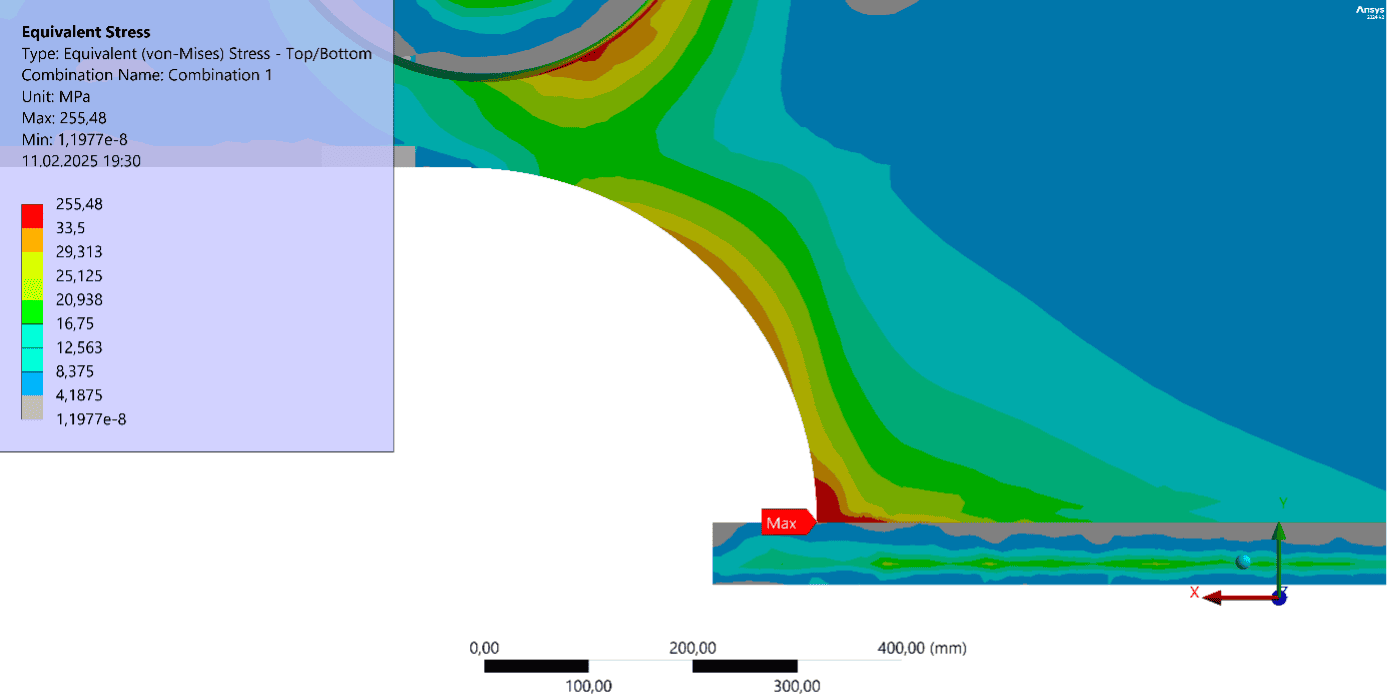
The FKM guideline offers the advantage of providing a systematic and transparent procedure for verifying fatigue strength. Based on this, we were able to quantify the critical areas in the top carriage and assess their remaining service life. This made it possible to categorize the damage that had already occurred and estimate the impact on future operational safety.
Results: Simulation and Reality in Harmony
The evaluation yielded a clear insight: the calculated high-stress areas corresponded exactly to the damage locations occurring in reality. This proved that the cracks were not accidental but a direct consequence of the operational load collectives.
This agreement between model and reality is a decisive advantage of modern simulation technology. It creates confidence in the results and enables statements to be made with a high degree of certainty regarding the future development of the damage.
Furthermore, based on the FKM calculations, we were able to predict the fatigue life of the affected areas. This made it possible to assess the risk of progressive damage and derive well-founded recommendations for action.
Repair instead of Replacement – the Economical Solution
Based on the analysis and the assessment according to the FKM guideline, we developed various measures to reinforce the top carriage. The goal was to strengthen the high-stress areas so that further crack formation is stopped and safe continued use is possible.
The implementation of these measures by the operator had several advantages:
- Avoidance of a costly replacement: A complete replacement of the carriage would not only have caused high material and assembly costs but also a longer interruption of warehouse operations.
- Minimization of downtimes: Through targeted repair and reinforcement, the machine could be put back into operation significantly faster.
- Ensuring operational safety: The measures increased the service life and reduced the risk of further damage.
Conclusion: Added Value through Simulation according to Recognized Standards
The project exemplarily shows the added value that numerical simulations offer in everyday industrial operations. They are not only a tool for developing new products but also a crucial component in the assessment and maintenance of existing systems.
Especially for dynamically loaded systems such as storage and retrieval machines, FEA allows critical areas to be precisely identified and their future development to be predicted. The application of the FKM guideline ensures that the assessment is based on a recognized engineering standard – transparent, practical, and reliable.
For operators, this means: well-founded decisions instead of costly uncertainties. Whether replacement, reinforcement, or repair – the analysis provides the basis for the economically and technically optimal solution.
Outlook
The approach of integrating real operating data into the simulation and assessing it according to the FKM guideline can be transferred to many other applications – whether in materials handling, mechanical engineering, or energy supply. Wherever components are cyclically loaded, modern methods of fatigue analysis can identify critical areas and initiate measures in good time.
This makes it clear: Simulation according to the FKM standard is a central tool for predictive maintenance. It makes the difference between costly downtime and the safe, efficient continued use of existing systems.
If you are also faced with the decision of whether components should be replaced or repaired, we support you with practical simulations and assessments according to the FKM guideline. This provides you with a reliable basis for economically and technically optimal decisions – before cost-intensive failures occur.
👉 Please feel free to contact us to learn more about our services in the areas of FEA, fatigue analysis, and service life predictions. Together, we will find the right solution for your challenge.